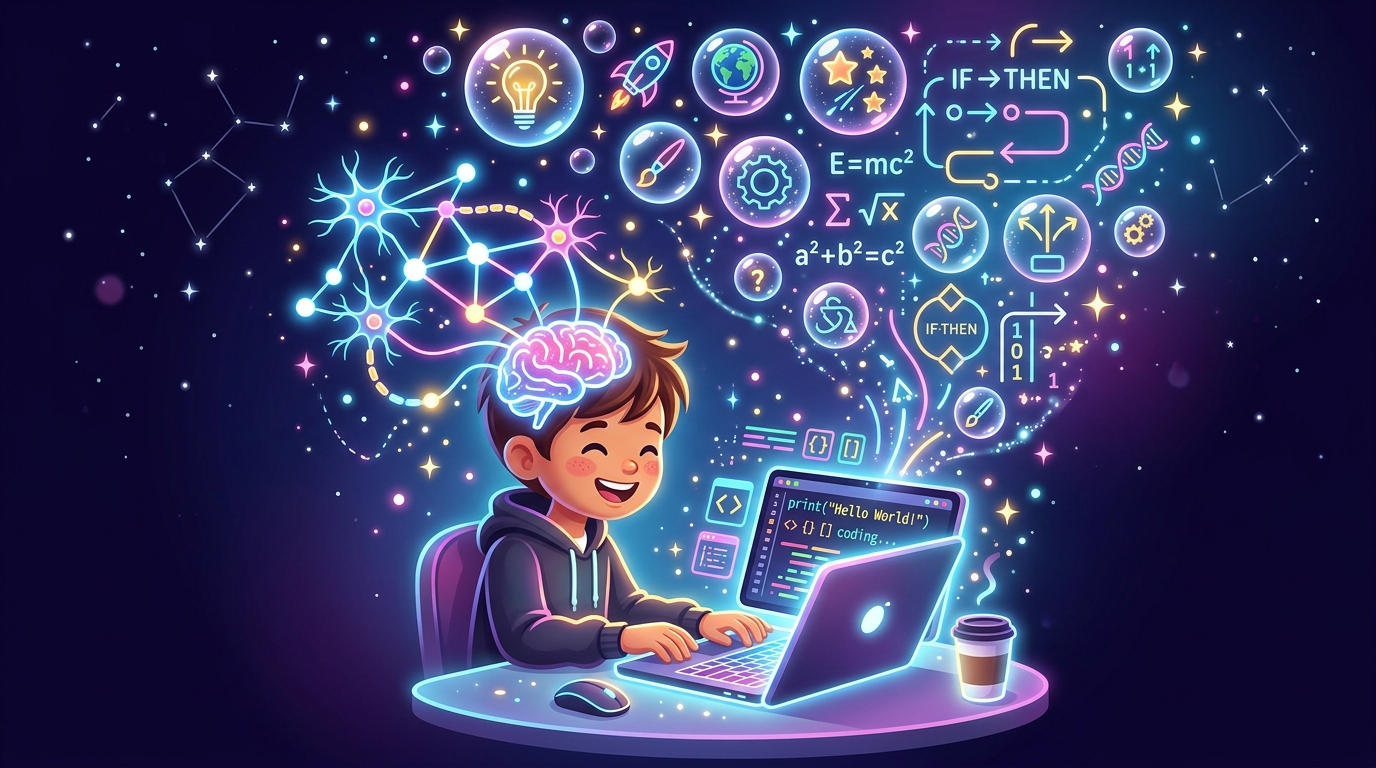
For parents of children with Attention Deficit Hyperactivity Disorder (ADHD), finding activities that hold attention, channel energy productively, and build self-esteem can be a long challenge.
Standard school structures often emphasize passive listening and rigid compliance, which run counter to the quick-moving, hyper-focused nature of an ADHD mind. Surprisingly, computer programming is emerging as one of the most therapeutically beneficial tools for neurodivergent children. In this post, we explain how learning to code trains attention, builds perseverance, and leverages ADHD as a superpower.
1. Channelling the Power of Hyper-Focus
One of the defining features of ADHD is not a complete lack of attention, but rather a difficulty in directing it. Under the right conditions, a child with ADHD can enter a state of "hyper-focus," working on a single task for hours with intense dedication.
Coding provides the ideal environment to trigger hyper-focus:
- Immediate Visual Outputs: Unlike text worksheets, drag-and-drop block coding (like Scratch) or simple game development yields instant results. A child changes a variable, and a game character jumps higher. This quick feedback loop feeds the brain's dopamine path, holding engagement.
- Stealth Learning: Kids do not feel like they are doing schoolwork. They feel like they are solving a puzzle or designing a game level, which removes behavioral friction.
Parent Testimonial:
"My son has ADHD and struggled to sit still for 10 minutes in regular school. After enrolling him in ABCCoders' private Scratch program, I watched him spend 45 minutes straight debug-fixing a maze game he was building. The 1:1 format changed everything!"
— Priya S., Bangalore
2. Reframing Errors as "Debugging" (Perseverance)
Children with ADHD often have low frustration tolerance. Rejection sensitive dysphoria and negative feedback loops in school can make them give up easily.
In programming, failure is not a grade; it is just a "bug" that needs tracking down. There is no moral failure in a bug. The teacher does not say "you are wrong"; instead, the script editor shows an error. The task becomes active problem-solving: how do we debug this? This reframing builds grit, patience, and teachable perseverance that carries directly into daily academic tasks.
3. Transforming Tech Consumers into Creators
Many kids with ADHD spend a lot of time playing video games (Minecraft, Roblox) because of the instant stimulation. This can lead to screen addiction conflicts.
By enrolling them in online coding classes for kids, you change their relationship with screens. They are no longer passive consumers hitting buttons. They learn the logic behind the triggers. They design the physics loops, code the item behaviors, and build the maps. It turns screen time into active, creative, and intellectual exercise.
Why 1:1 Online Coaching Works Best
Large cohorts or self-paced video lessons are typically ineffective for kids with ADHD. Pre-recorded tutorials cannot adapt to a child's distraction, and large groups often leave them feeling isolated or left behind.
At ABCCoders, we utilize a 1-on-1 private lesson delivery format. Our vetted computer science educators are trained to read attention levels in real-time. If the child gets distracted, the teacher dynamically shifts the project angle (e.g., adding a sound effect, customizing a sprite, or changing the game logic), keeping the student engaged and building momentum.
Unlock Your Child's Cognitive Focus
Schedule a free 1-on-1 demo session with one of our certified computer science mentors to experience the active project-first difference.
Book Free Demo Slot